Register now and start:
- Accessing PAR Training
- Shopping PAR products & tools
- Using online assessments with PARiConnect



PARiConnect saves time, offers insightful reports, & exceptional reliability!

We all have a set of cognitive processes that enable us to plan, organize, regulate behavior, and adapt to changing situations. These skills, collectively known as executive function, act as the brain’s command center. When executive function falters, the ripple effects can touch every aspect of life—from academic success and workplace performance to emotional well-being and independence.
Executive function isn’t static. It develops rapidly during childhood, peaks in early adulthood, and gradually declines as we age. Research shows that these changes can significantly impact learning, decision-making, and quality of life across the lifespan. For clinicians and mental health professionals, understanding and assessing these skills is more than best practice—it’s a critical step toward improving outcomes for individuals at every stage of life.
This blog is designed for clinicians, school psychologists, and mental health professionals who want to better understand executive function across the lifespan. It will outline three key reasons why assessing these skills at every stage of life is essential for improving outcomes and supporting long-term cognitive health.
There are three main types of executive functioning, these being working memory, cognitive flexibility, and inhibition control. A few conditions are known to affect executive functioning, as deficits are linked to conditions such as ADHD, autism spectrum disorder, depression, and dementia.
The connection between ADHD and executive function has been well studied, as ADHD directly impacts the ability to manage behaviors, remember details, and stay organized. This is evident in both adults and adolescents, though recognizing the signs of executive dysfunction can become more difficult in adulthood. This is because many adults learn to “mask” certain behaviors in order to compensate for difficulties and avoid stigma or social consequences.
Without timely assessment, these challenges can go unnoticed, leading to missed opportunities for intervention and support. By prioritizing executive function assessment using tools designed for specific age groups, clinicians can help individuals unlock their potential, maintain independence, and thrive in a world that demands flexibility and resilience.
This goes for other conditions as well, especially given the differences in how executive dysfunction appears at different stages of life. For example, it may be easier to notice when an elementary school student has trouble remembering instructions and controlling their impulses than a college-age student. Noticing changes in older adults is also critical, as this can be critical for early identification of conditions like Alzheimer’s and dementia.
Let’s dive deeper into three key reasons why clinicians should assess executive function across the lifespan:
Transitioning from high school to adulthood is a pivotal time for all students, but it can be especially challenging for those with disabilities. Student transition plans are designed to help these individuals prepare for life after high school by building the practical skills needed for success in college, vocational training, employment, independent living, and community participation. Under the Individuals with Disabilities Education Act (IDEA), schools are required to provide transition planning for students with Individualized Education Programs (IEPs), typically beginning between ages 14 and 16, though this varies by state. The process is highly collaborative, involving students, families, educators, and clinicians, and is tailored to each student’s strengths, needs, and aspirations.
A critical component of effective transition planning is the assessment of executive functions—cognitive processes that enable goal-setting, organization, self-regulation, and adaptability. These skills are essential for navigating new environments and meeting the demands of adult life.
Tools like the Behavior Rating Inventory of Executive Function, Second Edition (BRIEF2) and its Adult Version (BRIEF2A) provide clinicians and educators with valuable insights into a student’s executive functioning. By identifying areas of strength and need, these assessments inform the development of personalized transition plans and support strategies that empower students to achieve greater independence and long-term success.
Early identification of executive function challenges is crucial for effective intervention and long-term success. When clinicians assess executive functioning early—whether in children, adolescents, or adults—they can pinpoint specific areas of difficulty that may otherwise go unnoticed. This proactive approach enables timely support, helping individuals overcome obstacles related to attention, organization, self-regulation, and adaptability. For those with conditions such as ADHD, anxiety, or traumatic brain injury, early assessment is especially valuable, as it lays the groundwork for targeted interventions that address each person’s unique needs.
Personalized treatment plans are most effective when they are informed by comprehensive executive function data. Tools like the BRIEF2 and BRIEF2A provide clinicians with actionable insights, allowing them to tailor interventions and support strategies to each individual’s strengths and challenges. Regular progress monitoring through ongoing assessment ensures that treatment remains responsive and evidence-based. By tracking improvements and adjusting strategies as needed, clinicians can demonstrate measurable outcomes, reinforce positive change, and empower individuals to achieve greater independence and success in daily life.
As we age, it’s normal for executive function to decline to decline to some degree. Research consistently shows that older adults experience changes in executive abilities such as working memory, inhibition, and cognitive flexibility, which can impact independence, decision-making, and daily functioning. This decline is not only a hallmark of healthy aging but is also more pronounced in age-related conditions like mild cognitive impairment and dementia, including Alzheimer’s disease. The American Psychological Association underscores the importance of routine cognitive and executive function assessment in older adults, as early identification of changes can guide interventions that help maintain autonomy and quality of life.
Assessing EF in later life—and even in mid-life—helps identify cognitive changes early, guiding strategies to maintain autonomy and prevent decline. This proactive approach supports quality of life and reduces the risk of more severe impairment, especially for adults with Alzheimer’s or other advanced forms of cognitive decline.
There are key differences in how executive function is measured in adults compared to adolescents, which is why using the right tools is critical. The Behavior Rating Inventory of Executive Function, Second Edition (BRIEF2) is an example of one tool specifically designed to screen for executive function impairment in ages 5–18 years (parent & teacher forms) and 11–18 years (self-report form). Similarly, the Behavior Rating Inventory of Executive Function, Second Edition–Adult Version (BRIEF2A) is designed to assess adult executive functioning.
As EF is directly correlated to a variety of conditions—including ADHD, dementia, and traumatic brain injury (TBI)—that can occur at various stages of life, measuring it across the lifespan can make a major difference.
The new BRIEF2/BRIEF2A Combo Kit offers clinicians a comprehensive solution for evaluating executive function across age groups. Key features include:
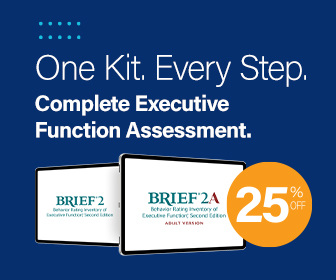
By combining tools for children, adolescents, and adults, the kit streamlines assessment and supports continuity of care. Clinicians can confidently evaluate EF at any stage, ensuring interventions are timely and effective.
Executive function is the foundation of how we navigate life—it shapes how we learn, work, and live. Its impact is profound and far-reaching, influencing academic achievement, workplace performance, emotional well-being, and independence. By making executive function assessment a routine part of clinical practice, clinicians can identify challenges early, tailor interventions to individual needs, and support cognitive health well into older adulthood.
The BRIEF2/BRIEF2A Combo Kit offers a comprehensive, evidence-based solution for evaluating executive function across the lifespan, empowering clinicians to deliver timely, personalized care and track progress over time.
Ready to take the next step? Explore the BRIEF2/BRIEF2A Combo Kit and start assessing executive function with confidence.